General Auguste-François-Marie Colbert de Chabanais met Murat in 1797, and served as his aide-de-camp in Italy and Egypt, where he was badly wounded; he returned to serve under Murat once more just before the battle of Marengo. In 1803, Murat attended his wedding. Colbert was a promising young officer rising quickly through the ranks; like Murat, he was a général de brigade before his thirtieth birthday. But on 3 January 1809, he was mortally wounded by a British sharpshooter in Spain, at only thirty-one years old. His son, Napoléon-Joseph-Auguste, Marquis de Colbert-Chabanais, drawing from family documents and manuscripts, letters, contemporary memoirs, and his own memories, produced a five-volume memoir on his father’s life, published between 1863 and 1873. The first volume provides the colorful description of Murat below.
Source: N.-J. Colbert, Traditions et souvenirs, ou, Memoires touchant le temps et la vie du General August Colbert, Vol. I (Paris: 1863), pages 91-94.
***
I arrive at last to General Murat, with whom Auguste Colbert was to have such close relations for more than two years.[1] Murat, then about twenty-six years old, was born in La Bastide, near Cahors, where his parents kept an inn. After some studies, he entered, it is said, into the seminary. Of a lively, fiery character, a temperament full of ardor and very eager for all the joys of this world, nothing suited him less than the little collar; so he hastened to exchange it for a cavalier’s jacket and to enter into the chausseurs of the Ardennes. There was a bad affair, he deserted[2] and came to take refuge in Paris. At the formation of the Constitutional Guard of Louis XVI, he joined it, and, when it was dismissed, left it with the rank of sous-lieutenant. It was then that by ambition, to make himself noticed, he displayed the most ridiculous revolutionary opinions, which, in fact, served his advancement. He rapidly became a lieutenant colonel; but on the 9th of Thermidor, he suffered the effects of the reaction and lost his employment. Being in Paris on the 13th of Vendemiaire, he was going to offer his services to the Convention. General Bonaparte had need of a cavalry officer and a resolute man: he charged Murat to go, during the night, to seize the artillery that was on the plain of Sablons and to bring it to Paris. This rapidly executed strike was decisive for the next day’s fight. From then on, Murat remained attached to General Bonaparte, who took him as an aide-de-camp. He distinguished himself in Italy and was charged with bringing to Paris the flags taken at Mondovi. Sometime after, he was made brigadier general.
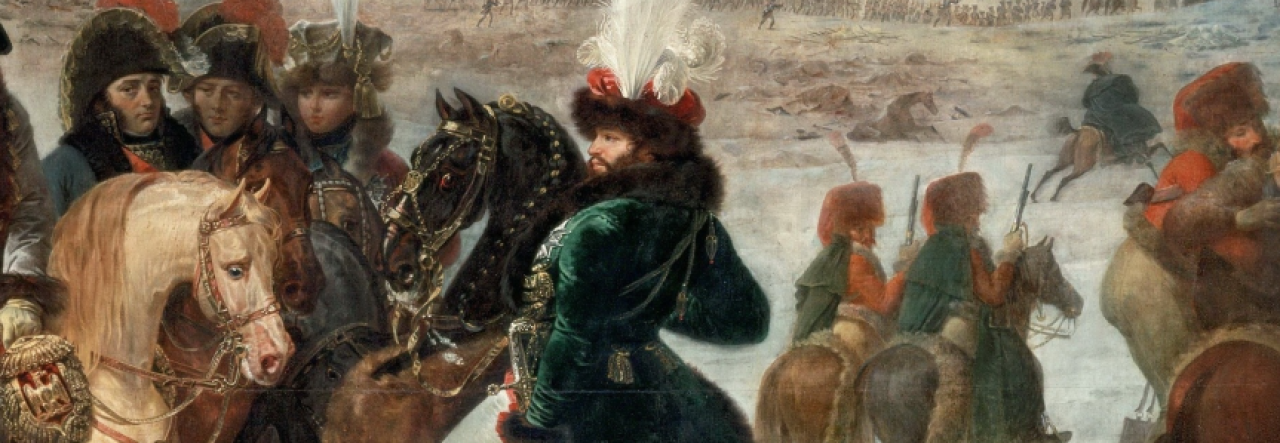
There was something special about Murat, that his courage, which was his dominant quality, always grew with his position. In Italy, he was brave, but as much as the others; in Egypt, he began to put himself outside the line; as Marshal of France, Grand Duke of Berg, he scarcely had equals; as King of Naples, in Russia and in the campaign of 1813, he astonished the most intrepid, and, according to the expression of a man extremely knowledgeable himself about courage: “he was enough to make the bravest take a step back.” Child of the Midi, of a nature entirely southern in which the senses played a very big role, Murat loved everything that had sparkle, everything that shines in the sun, the beautiful uniforms in various colors, the floating plumes, the rich harnesses on stamping horses. A true paladin, he had devoted his worship to glory and beauty and wore this motto engraved on his saber: For honor and the ladies.
At camp, in the face of the enemy, he loved to find the joys of luxury and all the softness of the desired life. This was a type of defiance, one more way to brave danger. “But, while sleeping in a bed, if you are surprised, what will you do?” someone said to him one day. “Well! I’ll get on my horse in my shirt: people will see me better.” That is the man entirely.
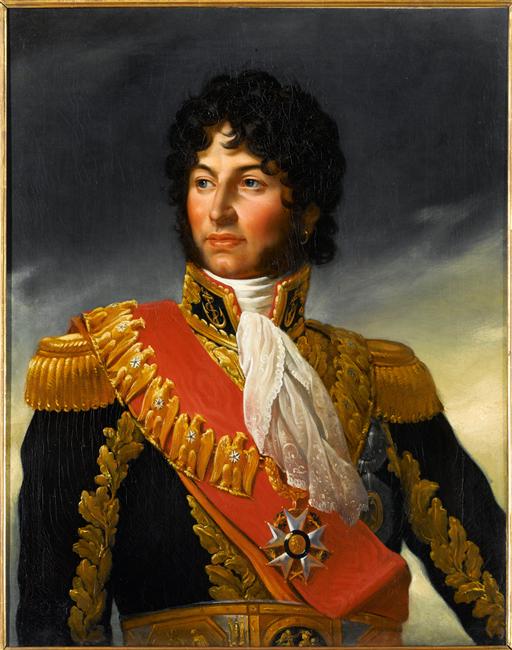
Murat was of a height a little above average, and well made. Yet there was in his appearance more strength than elegance. Hair black and abundant, falling in curls on each side, framed his visage. His traits had none of what constitutes beauty, finesse, distinction. In sum, Murat might have had a common air in a salon; but when on a day of a battle he was on horseback, at the head of his squadrons, when he dashed through the grapeshot or rushed, a riding crop in hand, into the thickest ranks, oh! Then Murat was handsome, and nothing could resist the hurricane that he brought with him.
[1] [My note] Colbert served for a time as Murat’s aide-de-camp.
[2] [My note] He was actually dismissed from service; the details of the incident remain vague, but according to both Jean Tulard and Vincent Haegele, the affair was political in nature. Tulard writes of a mutiny occurring in the unit and wonders whether Murat was one of the leaders of it; Haegele writes that Murat was expressing subversive sentiments at a time when the army was still devoted to the monarchy.
***

