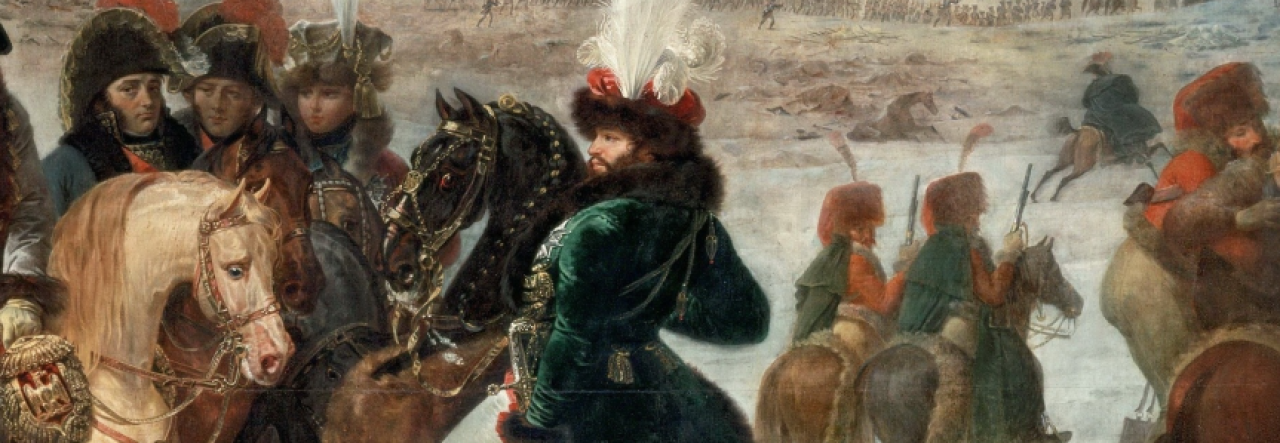
A little interlude before I get back to translating Vandal: three letters from Napoleon’s chief of staff, Marshal Louis-Alexandre Berthier, to Murat. The first letter is written weeks before Murat was officially crowned King of Naples; the other two are several months into his reign, carrying into the 1809 campaign, which Murat was forced to …
Tag: History
“Surrender yourself thus to his orders”
Part 4 of my translation of Albert Vandal’s Le Roi et la Reine de Naples. Caroline Murat is in Paris, preparing for Napoleon's second wedding, while her husband remains in Naples. The Emperor, perhaps hoping to drive a further wedge in the marriage of his youngest sister and Murat, offers her the prestigious position of superintendent of …
“Discreet complaints and… caressing reproaches”
Part 3 of my translation of Albert Vandal’s Le Roi et la Reine de Naples. We have the beginning of what will be, for Caroline, a very long period away from Naples--first to be present for the proceedings of Napoleon's divorce from Josephine (an event which Caroline was arguably instrumental in helping bring about), and …
Continue reading “Discreet complaints and… caressing reproaches”
“A permanent state of distrust”
Part 2 of my translation of Albert Vandal's Le Roi et la Reine de Naples. In this part, Vandal describes the rifts which began developing between Joachim and Caroline Murat soon after taking the throne of Naples. These largely stemmed from Murat's insecurities about being potentially overshadowed--or dominated--by his wife, especially due to Napoleon's wording …
“For your subjects, be king; for the Emperor, be viceroy.”
This is Part 1 of what is probably going to be a very long translation project. If there is one part of Murat's life which is less well understood than any other, it is his reign as King of Naples. Military historians naturally place more of an emphasis on Murat as a cavalry commander, his …
Continue reading “For your subjects, be king; for the Emperor, be viceroy.”
“It once served… one of our most valiant sovereigns”
Murat entered Warsaw on the 28th of November, 1806, enthusiastically welcomed by the Poles, who believed the French would bring them independence. Even the Duchess d'Abrantes, who was no great admirer of Murat, wrote of that his "splendid type of chivalrous valour... pleased that brave and most impressionable people, which was ready to follow with …
Continue reading “It once served… one of our most valiant sovereigns”
“I had gone to him… in true despair”
My good friend JosefaVomJaaga has graciously allowed me to share her translation of an excerpt on Murat from Friedrich von Müller’s Erinnerungen aus den Kriegszeiten von (Memoirs of the Wartime of) 1806-1813. Müller (1779-1849) was a Bavarian statesman, and a friend of Goethe; he would eventually manage to persuade Napoleon to permit Weimar to retain …
“The public tranquility was troubled this morning…”
Murat was sent to Spain in February of 1808, to act as Napoleon’s lieutenant and take command of all French forces in the country. Spain was in political turmoil, its citizens on the brink of revolt against the unpopular minister Godoy. Napoleon, having not yet determined on what course of action he wished to pursue, …
Continue reading “The public tranquility was troubled this morning…”
“His Gascon rants”
Continuing with excerpts from the memoirs of General Griois pertaining to Murat during the 1812 campaign, we have a description from Griois of a confrontation between Murat and an unnamed Russian general over the position of Russian outposts during a truce. Murat is also outraged that a Cossack recently took a shot at him (as General Caulaincourt …
“The people perceived… the sad exchange they had made”
In the last excerpt I posted from the memoirs of Dedem--who was no admirer of Murat--we see Dedem praise Murat for ruling in the interests of his subjects, for reforming and modernizing the Neapolitan administrative, financial, and judicial systems, and for instituting various public works projects. I've found some more excerpts that echo Dedem's sentiments …
Continue reading “The people perceived… the sad exchange they had made”
 Project Murat