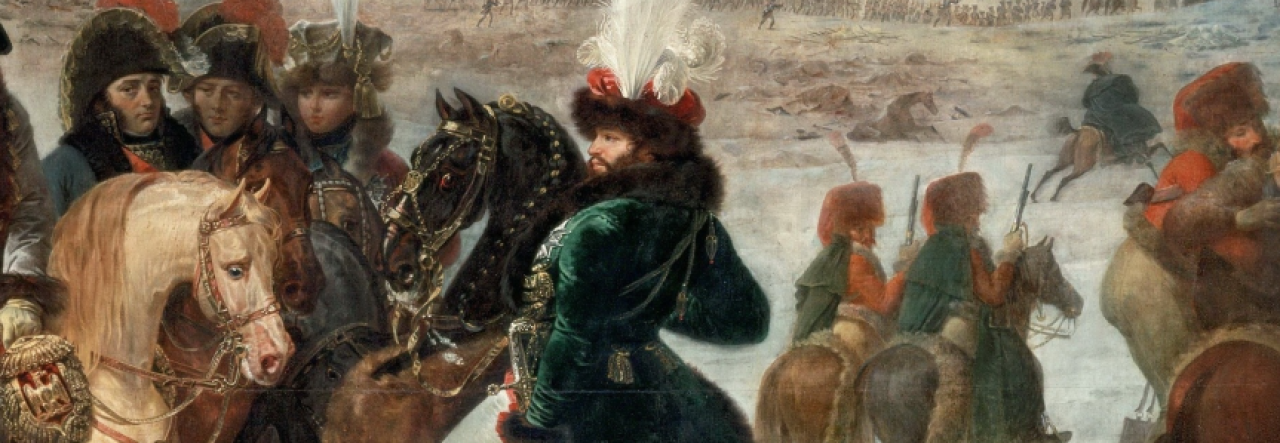
Following his final defeat against Austria at the battle of Tolentino at the beginning of May 1815, Murat made a hasty retreat to Naples. Advised by Caroline to depart the kingdom, as the Austrians and English flat-out refused to deal with him, Murat left Naples the day after his return, and soon made his way …
Author: Sarah
History lover. Highly caffeinated. Introverted. Devoted to researching/writing about Murat, and translating his letters; someday I would like to publish at least one book about him. Slightly obsessed.
“We would be driven to a state of barbarism”
Continuing with Louise Murat's memoirs, we arrive at Murat's decision, in 1815, to march in support of Napoleon following his brother-in-law's triumphant return from Elba. Murat had been urged by Joseph Bonaparte to try to convince Emperor Francis of Austria to ally himself to Napoleon; but the letter Murat ends up sending Francis towards the …
Continue reading “We would be driven to a state of barbarism”
“My annoying opposition to his politics”
Part 3 of Murat-related excerpts from the memoirs of Neapolitan General Guglielmo Pépé. In this excerpt, Pépé discusses the first, ultimately unsuccessful attempt at pushing King Joachim to grant the Neapolitans a constitution in 1814; Lord William Bentinck's personal dislike for Murat; and Murat's inclination towards rewarding those of his generals whose politics (unlike Pépé's) …
“You can never know how attached to you I am”
Today--25 March--is the shared birthday of Joachim & Caroline Murat (in 1767 & 1782, respectively), so I've put together a little something to provide some insight into their relationship. There's one period in particular during which an abundance of letters exists from Caroline to Joachim: their long separation(s) during most of 1810. Joachim and Caroline …
Continue reading “You can never know how attached to you I am”
“The false words attributed to him”
Emmanuel-Augustin-Dieudonné-Joseph, Count de Las Cases, was one of the few men to voluntarily accompany Napoleon into exile on Saint Helena, along with his son. There, he served the deposed Emperor as a secretary, recording numerous conversations with Napoleon and taking extensive notes, which he later turned into the Mémorial de Sainte-Hélène following his expulsion from the island …
“I could have fallen at his feet and worshipped him”
Part 2 of Murat-related excerpts from the memoirs of Guglielmo Pépé. This part begins with Pépé's recollection of his first meeting with Murat in Florence in 1802, continues with the crowning and general reception of Murat as King of Naples six years later (and their reaction to Napoleon naming Caroline his immediate heir), and ends …
Continue reading “I could have fallen at his feet and worshipped him”
“They led him to his doom.”
In this excerpt from Louise Murat's memoirs, Louise discusses how her father became drawn into the cause of Italian unification, why he broke away from the Allies in 1815, and his final, disastrous campaign against Austria. Source: Louise Murat, Souvenirs d’enfance d’une fille de Joachim Murat, pages 206-213. *** It was thus that after fall of Napoleon, tranquility was …
“By no means insensible to flattery”
Guglielmo Pépé was a Neapolitan general, born in Calabria in 1783. Entering Napoleon's army after having fought against the Bourbons in Naples, he would return to his native country to serve in the Neapolitan army during the reigns of both Joseph Bonaparte and Murat. His relationship with Murat was complicated. Pépé was a Neapolitan patriot …
A (slightly) new direction…
So this blog is a little over two years old now! It started off as just a way for me to share some random bits and pieces about Murat for no real purpose other than just wanting to share my interest in him with others. But as I’ve gotten deeper into my research and numerous …
“A colleague whose presence offended their gaze”
In this excerpt from Louise Murat's memoirs, Louise discusses the reconciliation between Murat and Napoleon, the political situation during the First Restoration which eventually led to her father breaking away from his new allies, and counters a number of criticisms of her father's conduct in 1815. Source: Louise Murat, Souvenirs d'enfance d'une fille de Joachim Murat, pages 196-206. …
Continue reading “A colleague whose presence offended their gaze”
 Project Murat