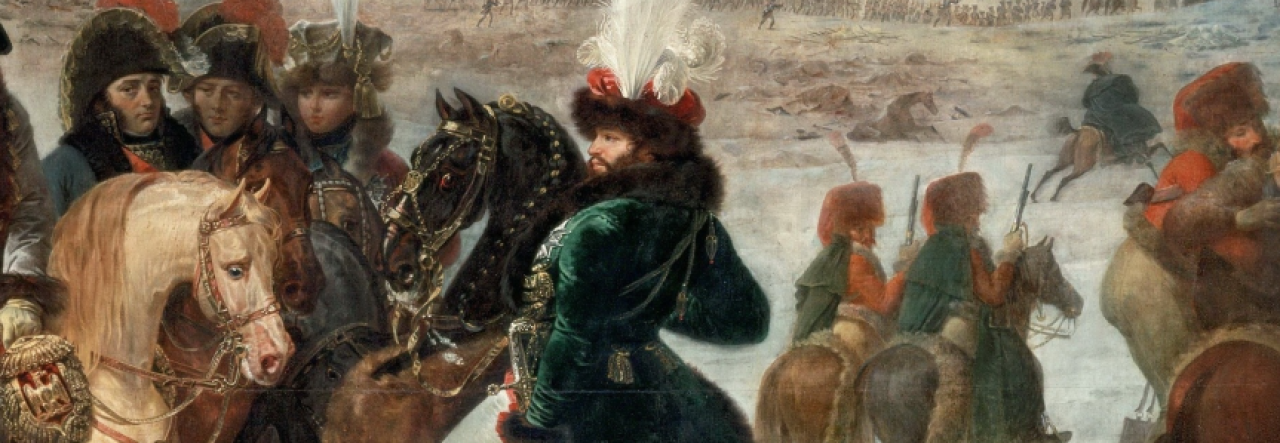
“It once served… one of our most valiant sovereigns”

Murat entered Warsaw on the 28th of November, 1806, enthusiastically welcomed by the Poles, who believed the French would bring them independence. Even the Duchess d'Abrantes, who was no great admirer of Murat, wrote of that his "splendid type of chivalrous valour... pleased that brave and most impressionable people, which was ready to follow with …

Continue reading “It once served… one of our most valiant sovereigns”

“I had gone to him… in true despair”

My good friend JosefaVomJaaga has graciously allowed me to share her translation of an excerpt on Murat from Friedrich von Müller’s Erinnerungen aus den Kriegszeiten von (Memoirs of the Wartime of) 1806-1813. Müller (1779-1849) was a Bavarian statesman, and a friend of Goethe; he would eventually manage to persuade Napoleon to permit Weimar to retain …

Continue reading “I had gone to him… in true despair”

“The public tranquility was troubled this morning…”

Murat was sent to Spain in February of 1808, to act as Napoleon’s lieutenant and take command of all French forces in the country. Spain was in political turmoil, its citizens on the brink of revolt against the unpopular minister Godoy. Napoleon, having not yet determined on what course of action he wished to pursue, …

Continue reading “The public tranquility was troubled this morning…”

“A time of continuous fête and revelry”

To commemorate Joachim & Caroline Murat's shared birthday (25 March of 1767 and 1782, respectively) this year, I've compiled some accounts recorded by three visitors to Naples--two English and one Irish--between the fall of Napoleon in 1814 and his return from Elba in 1815. The first account is from the English poet Samuel Rogers; the …

Continue reading “A time of continuous fête and revelry”

“Captivity and death are to me synonymous.”

On 28 September, 1815, Murat made his fateful decision to reject the Austrian passports and offer of asylum brought to him by his former aide-de-camp, Francis Macirone, who had received them from Metternich; Murat was expected, under the designated terms, to abdicate and choose a name to live under as a private citizen (Caroline Murat …

Continue reading “Captivity and death are to me synonymous.”

“He had nonetheless ceased to reign”

The second part of General Belliard’s account of the events following his arrival in Naples in April 1815. Following Murat’s failed campaign against Austria, both the Austrians and English refuse to have any further dealings with him, and will negotiate terms only with his wife, Queen Caroline. Murat’s reign comes to an abrupt end; he …

Continue reading “He had nonetheless ceased to reign”